Skip to content
  • About
  • Contact


0

Cancer Rehab PT Logo
Programs

Programs

Browse our rehabilitation programs.

  • Breast Cancer Rehab
  • Lower Body Lymphedema Rehab
  • Healthy Shoulder Program
Blog

Explore the blog

  • Breast Cancer
  • Cancer Rehab
  • Lymphedema
  • Lymphatic Health
  • Exercises
  • Tips & Tricks
  • View all articles
  • 6 Exercises for Breast Lymphedema to Reduce Swelling

  • Exercise After Mastectomy: Guide from a Physical Therapist

  • From the blog

    Free 3-Day Lymphatic Vibration Challenge

Shop

Shop resources

  • Affiliate Products
  • Digital Guides
  • Free Downloads
Manual Lymphatic Drainage Guide for Both Legs – Digital$15.00
Head, Neck and Face Manual Lymphatic Drainage Guide – Digital$15.00
Exercises for Leg Swelling and Lymphedema$10.00
For Health Professionals

For health professionals

Courses and educational resources.

  • Fibrosis Management in Rehabilitation
  • Breast Cancer Rehab Collection
  • Lymphedema Patient Education Bundle
  • Courses and Events
  • About
  • Contact


0

Subscribe to our newsletter

Educational content, round-ups of resources, highlights of topics & tips, and more! 

Please enable JavaScript in your browser to complete this form.
Loading

Lumebox

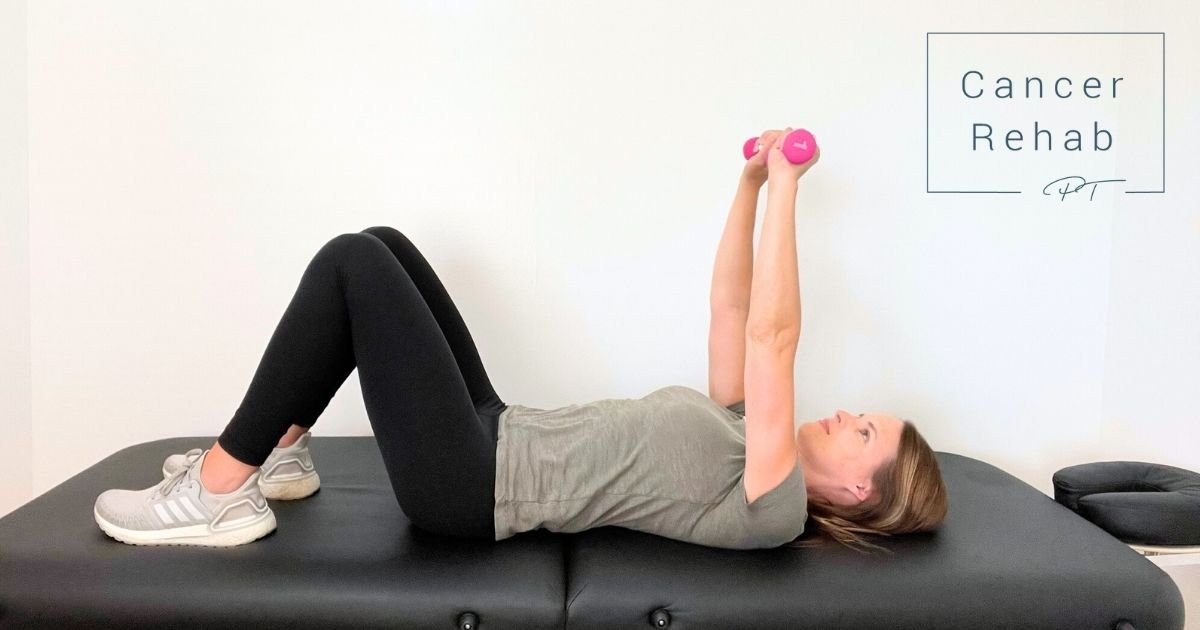
6 Exercises for Breast Lymphedema to Reduce Swelling

If you develop swelling in your chest after breast cancer treatment, try these exercises for breast lymphedema to reduce discomfort.

  • View all topics
  • Breast Cancer
  • Cancer Rehab
  • Lymphedema
  • Lymphatic Health
  • Exercises
  • Tips & Tricks
When your shoulder feels tight after breast cancer When your shoulder feels tight after breast cancer surgery, one of the first places I check is your armpit, because a cord there can pull on your shoulder and arm.

I’m looking in your armpit, your inner chest, your inner arm, and sometimes along the chest wall for tissue that pulls tight. I’m checking for the cord itself, or for a scar that has stuck down to the tissue underneath.

You may also hear it called axillary web syndrome or axillary cording. Sometimes you can see or feel the cord under the skin, kind of like a guitar cord. 

Other times you can’t see it at all, but you feel it when you reach overhead or try to get dressed.

Cording is thought to come from the lymph vessels and tissue in the armpit tightening into a cord after lymph nodes are checked or removed, and it can show up weeks after surgery or months later. 

The cord is often only part of it, since a tight chest wall, a stiff shoulder, and keeping your arm tucked against your side without noticing can all add to the pull.

On its own, cording mainly causes tightness and restriction, and it can limit how far your arm and shoulder move.

What we do depends on what’s driving yours, but most often we’re:
▪️using hands-on techniques in the area and along the scar 
▪️gentle movement and stretching for the shoulder 
▪️exercises like nerve glides to help loosen the cord from whatever it’s stuck to
▪️strengthening to keep your muscles healthy so other muscles don’t have to compensate and cause pain

Unfortunately, most people are not warned about cording before it happens, so they don’t always know what to look for and rarely know what to do if they notice it. 

Cording after surgery is very common, and it’s thought to affect up to 80% of people in some capacity. Some cords go away on their own, and some need support. 

An oncology PT or certified lymphedema therapist can help with treatment to speed up the release of the cord and get your range of motion back.

I hope this helps.

Please speak with your doctor or CLT regarding any medical concerns, as this is not personalized treatment, but rather general education.
That tight, rope-like pull from your armpit down i That tight, rope-like pull from your armpit down into your arm after breast cancer surgery is called axillary cording.

It can show up weeks or even months after surgery, and a lot of people aren’t told to expect it. Reaching overhead or sliding your arm into a jacket can all of a sudden feel like pulling against a guitar string. 

For some people, cording is painful, for others it isn’t. Either way, it can be annoying. 😒

I see cording all the time after lymph node removal, and the good news is it often responds well to gentle, consistent movement and most cords go away within weeks to a few months.

With this exercise, I like to hold right at the scar, or wherever the cord starts, to anchor that end so the movement works on the cord itself and doesn’t get limited by the muscles around it. I find it tends to release more this way than with a big stretch.

You’re looking for a mild pull along the cord. If it turns sharp or burning, back off a little. Pushing harder can irritate the cord and make it tighter.
Some people feel a small pop as a cord lets go. That’s common, but you don’t need to go looking for it. 

If you notice redness, warmth, new swelling in your arm, or a fever, reach out to your care team. Those aren’t typical for cording and are worth getting checked.

📌 Save this for when you need it.

I hope this helps 💕

*Please speak with your doctor or CLT regarding any medical concerns, as this is not personalized treatment, but rather general education.

#axillarywebsyndrome #cording #breastcancerrecovery
If you’ve had a neck dissection or radiation for h If you’ve had a neck dissection or radiation for head and neck cancer, scar tissue along the neck is incredibly common, and can often block fluid flow, adding to swelling.

A few signs it might be worth having someone take a closer look:
- Stiffness turning your head more to one side than the other. 
- Tightness that runs along your jawline or down toward your collarbone. 
- Swelling in the neck or face that isn’t improving the way you’d expect.

None of these automatically mean something is wrong, but they’re also things that can be helped to improve, even years later.

Scar tissue in this area can restrict how fluid moves through the neck. 
For swelling and lymphedema, lymphatic drainage can be very helpful and effective here, but even adding in 1-2 minutes a day with scar massage or gentle, hands-on work can make such a difference, both for mobility and for helping fluid move more freely again.

This is a sensitive and delicate area to work on, so therapists will keep it very gentle and avoid any deep pressure. But it’s important to know that there are techniques and treatments that can help.

If you aren’t sure where to start, look for a certified lymphedema therapist near you.

*Please speak with your doctor or CLT regarding any medical concerns, as this is not personalized treatment, but rather general education.
So many of you are navigating treatment or survivo So many of you are navigating treatment or survivorship completely on your own, symptoms, insurance, finding the right care, without a clear roadmap and without anyone telling you what’s actually normal.

There aren’t enough specialized therapists to go around, and cost and insurance make it even harder to get the care you need.

I keep talking about this because the more you understand your own symptoms, the more you can push for real answers instead of settling for “that’s normal.” And the more clinicians understand it too, the more patients get seen and get help, sooner.

We have a long way to go. But I want to stop and say this:

I see you. I hear you. I am sorry you’re having to deal with these side effects.
I appreciate you continuing to advocate, having hard conversations with your own medical team, and using your voice, even when it would be easier not to.

My original why for starting this account over 8 years ago was to bring awareness and decrease the number of times a week I heard “why didn’t I know about this sooner.” 

We haven’t eliminated it, but together, we’re making progress.
All 3 of these are so important! Scars after brea All 3 of these are so important!

Scars after breast cancer surgery may be visually there to see, but they can also be adhered to the tissue underneath.  This can limit your movement and cause tightness that lingers long after the incision has healed.

This is what I teach just about every person I work with who is going to try scar mobilization. A rehab therapist can help show you how to do it for yourself at home.

All should be gentle:

▪️ Cross-friction massage: using the fingertips, move perpendicular and then parallel to the scar. We want to work across the scar fibers.

▪️ Pinch and twist: gently pick up the skin at the scar and add a soft twist. If the tissue feels stuck and won’t lift easily we call that adherence, and that’s exactly why we want to work on it in rehab.

▪️ Pinch and roll: pick up the tissue and slowly roll through it. This helps soften the scar, break up adhesions, and get some blood flow back into the area. It’s my favorite :)

I most often start with a minute or two at a time, one to three times a day, but that will vary person to person. We always keep it pain-free and gentle the entire time. Sometimes we use lotion if that feels more comfortable, but it’s not always necessary, too. Either works as long as it feels okay.

If this is something you struggle with, reach out to an oncology therapist near you to ask about these treatments.

I hope this was helpful! 💕

Save this and share it with someone working through recovery after breast cancer surgery.

*This is general education, not personalized medical treatment. Please speak with your doctor or CLT regarding your specific needs.
Comment 3DAY and I’ll send you the free guide with Comment 3DAY and I’ll send you the free guide with access to all three videos.

Turning your vibration plate all the way up isn’t always the best idea. The setting matters more than the strength.

Thank you @lifeprousa for sponsoring this free challenge

If you bought a plate to help with swelling and you’re not sure you’re using it right, you’re not the only one. This is by far the most common question I get about vibration plates.

Keeping kind that your lymphatic vessels tend to respond best to gentle, rhythmic lymphatic drainage. 

A high setting on the vibration plate can be pretty intense for some, so I prefer a lower, steadier setting to keep it gentle.

The free 3-Day Vibration Plate Challenge includes 3 simple follow-along video routines, and I walk you through:

▪️which setting to start with and when to adjust it
▪️how to position yourself so the area you’re working on gets the benefit
▪️how long to stay on, and how to pair it with breathing and simple movement
▪️which vibration plate is best for beginners vs the advanced option

Comment 3DAY and I’ll send you the free guide with access to all three videos.

I hope this helps!

Please speak with your doctor or CLT regarding any medical concerns, as this is not personalized treatment, but rather general education.

Subscribe to our newsletter

Educational content, round-ups of resources, highlights of topics & tips, and more! 

Please enable JavaScript in your browser to complete this form.
Loading

Learn

  • About
  • Blog
  • Contact

Follow

  • YouTube
  • Instagram

Shop

  • Affiliate Products
  • Digital Guides
  • Free Downloads

Programs

  • Breast Cancer Rehab
  • Lower Body Lymphedema Rehab
  • Healthy Shoulder Program

Health Professionals

  • Fibrosis Management in Rehabilitation
  • Breast Cancer Rehab Collection
  • Lymphedema Patient Education Bundle

Disclosure: Some links on this page may be affiliate links. Cancer Rehab PT LLC participates in the Amazon Associates Program and others as an affiliate linking to products Kelly organically uses and trusts. We try our best to keep things fair and balanced to help you make the best choice for yourself. If you purchase a product through an affiliate link, your cost will be the same, but we may receive a small commission. There is no additional charge to you. Thank you for your support!

The content of this website does not replace the care of healthcare professionals and is in no way to be construed or substituted as any type of medical advice, diagnosis, or treatment but is for general education purposes only. Please read the full disclaimer here.

Do Not Sell or Share My Personal Information

© 2026 Cancer Rehab PT, LLC. All rights reserved.

|

Terms of Use

|

Privacy Policy

|

Accessibility | Website by Saevil Row + MTT + Deeper than Copy