




Continuing education for Rehab Professionals
Fibrosis Management in Rehabilitation
A focused CEU course in treating radiation fibrosis and lymphostatic fibrosis.
6.5 contact hours
Self-paced · Certificate on completion
By Kelly Sturm, PT, DPT, CLT-LANA, Board-Certified Oncology Clinical Specialist
Course for licensed clinicians. Looking for patient programs? See patient courses
6.5 contact hours
PT CEUs in 42+ states
Self-paced
Access does not expire
The Gap in the training
A patient told me her therapist finally said, “I don’t know how else to help you.”
That therapist was good. Trained in breast cancer, trained in lymphedema, clearly invested in her. Unfortunately, she had reached the end of what she was ever taught.
That is where a lot of clinicians are with fibrosis. The tissue is restricted, but it stops responding, and the training you have had has a gap right where you need. There is almost no research, mostly anecdotes, and nothing that gets into the clinical side of actually treating it. So you do your best with what you have and hope it is enough.
These patients are struggling, and they can feel it when we run out of answers.
We all know that patient. Most of us have more than one.
The framework
The Fibrosis Rehab Framework™
STEP 01
Identify
Is it fibrosis, and which type?
STEP 02
Differentiate
Or is it something else causing symptoms?
STEP 03
Assess
Read the tissue, layer by layer
STEP 04
Treat to tissue
Match technique to what you found
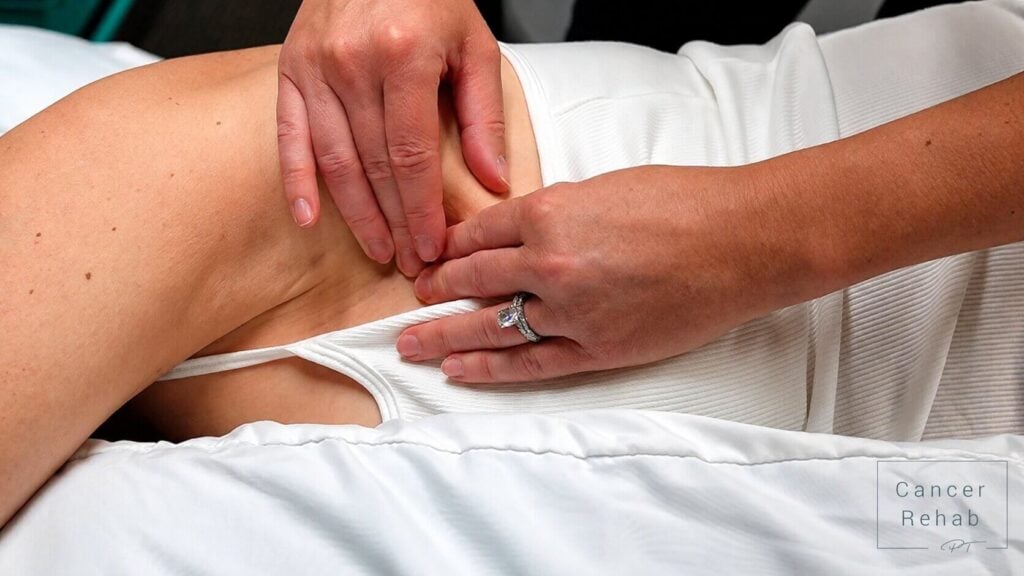
Most clinicians skip step two or three and end up applying fluid protocols to fibrotic tissue or miss the root cause of the tightness and pain, which is why the plateau shows up and stays.
physical therapy for cancer patients
Course content
Seven modules, what you’ll learn
The first three build the mechanism. The last four are where you spend most of your time, and where most of the demonstration lives.
MODULE 01
The Fibrosis Rehab Framework
The four-step sequence, and the clinical question each step answers.
MODULE 02
Radiation Fibrosis Syndrome
Why it keeps progressing years after treatment ends, how it presents.
MODULE 03
Lymphostatic Fibrosis
How fibrotic lymphedema forms, and the staging point where standard CDT starts to fall short and what to do next.
MODULE 04
Assessment: Reading the Tissue
Pinch-lift, tissue slide, depth palpation — how to assess via the 3-layer framework to optimize your treatment plan and then document and track.
MODULE 05
Treatment: Radiation Fibrosis
The longest module, where most of your treatment time goes: manual work, stretch parameters, and where strengthening fits.
MODULE 06
Treatment: Lymphostatic Fibrosis
Modified CDT for fibrotic tissue. Sequencing, pressure, pace, garment stiffness, and real transition criteria.
MODULE 07
The Combined Presentation
The patient with both. What to treat first, what to do when fibrosis is blocking access to the lymphatics, and when to co-manage medically.
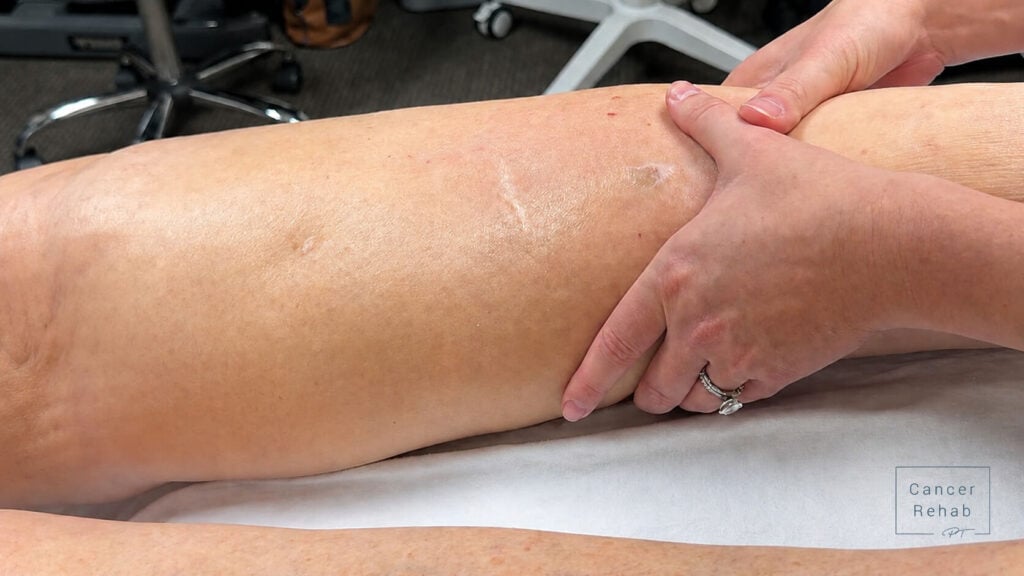
*Visual technique demonstration in this course is filmed on the chest wall and breast for radiation fibrosis and lower extremity for lymphostatic fibrosis, because these are the populations I treat most and where the visual detail is clearest. Head and neck, upper extremity, and pelvic are covered as regional presentations, and the assessment and treatment principles carry across all of them.
The Approach
There are still patients in front of you. This is the training I couldn’t find anywhere else.
I went looking for this course for years. Not just a course, either. Studies, protocols, a chapter, anything with actual technique in it. What exists is mostly description of the pathology and very little on what to do with your hands.
So most courses on this teach the literature that exists and stop, because that is the honest end of the evidence. You finish with a reference list.
This course keeps going. It is the framework I use to assess fibrotic tissue, the manual techniques I use to treat it, and patient cases showing how the decisions get made. Thirteen years of it.
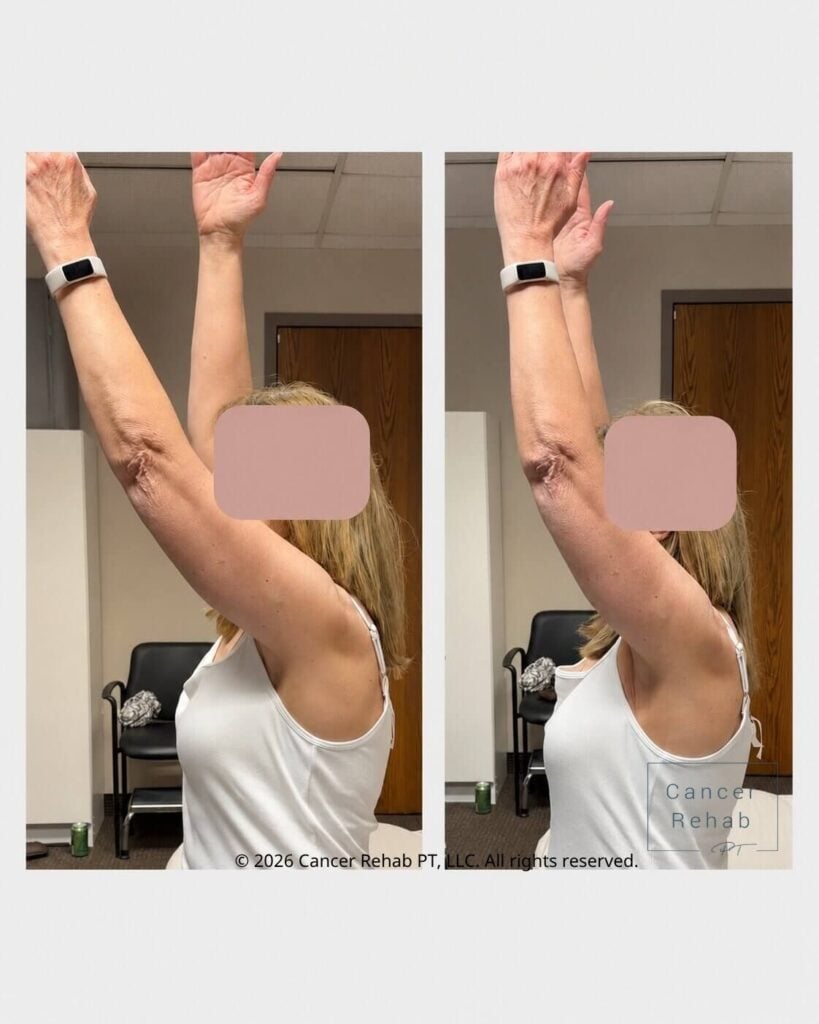
This patient came to me six years after breast cancer treatment, 22 lymph nodes removed. In one session, using techniques from this program, her shoulder flexion went from 115° to 135°.
Who this is for
Fibrosis was the footnote in your training. Now it’s the patient in front of you.
Built for you if
- You are a rehab professional treating patients with fibrotic tissue changes
- You are a CLT who has run the basic CDT protocol and hit a wall
- You’re newer to this caseload, or you’ve treated it for years and largely learned as you went
- You want hands-on technique and clinical reasoning you can use this week
Not the right fit if
- You still need the basics of lymphedema. This builds on that foundation; it doesn’t teach it from scratch.
- You want a course built around deep research review rather than clinical technique
- You are a patient looking for self-management guidance. Looking for patient programs? See patient courses
About the instructor
Radiation fibrosis and lymphostatic fibrosis are taught in two different worlds. I work in both.
Hi! I am Kelly Sturm, a physical therapist with a DPT from Mayo Clinic College of Medicine, a board-certified Oncology Clinical Specialist, and a LANA-certified lymphedema therapist. Thirteen years treating cancer survivors and people living with lymphedema. Most of what I teach came from patients who had already been told nothing more could be done.
I built this course because I kept looking for it and it did not exist.
CEU and approval
PT/PTA CEU Approval
Physical Therapy CEUs
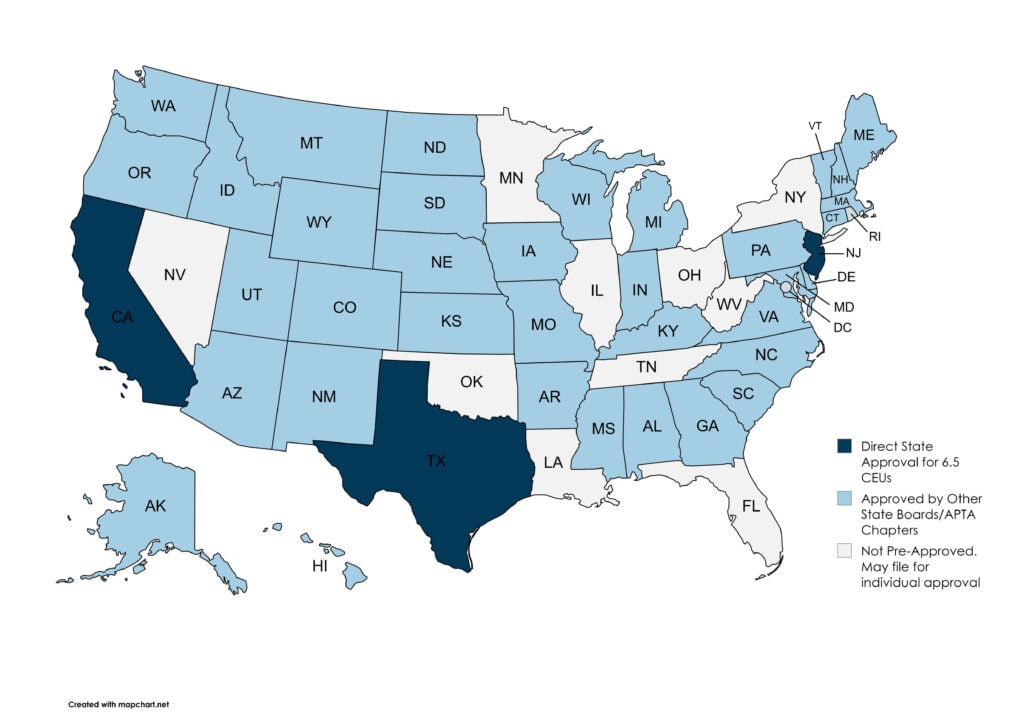
California: This course has been approved for 6.5 Hours by CEUApproval.com, LLC, a recognized approval agency of the Physical Therapy Board of California.
New Jersey: This course has been approved for 6.5 hours by New Jersey Board of Physical Therapy Examiners.
Texas: This course has been approved for 6.5 Hours by Texas Physical Therapy Association
Courses approved by other state boards in the following jurisdictions are likely accepted for licensure credit based on the state regulation:
AL | AK | AR | CO | CT | DE | GA | HI | ID | IN | IA | KS | KY | ME | MA | MI | MO | MT | NE | NH | NC | ND | NJ | OR | PA | RI | SC | SD | UT | VT | VA | VI | WA | WI | WY
Courses approved by other APTA chapters in the following jurisdictions are likely accepted for licensure credit based on the state regulation:
AZ | DC | MD | MS | NM
Please reach out to your state licensing board to confirm the currency and accuracy of this information. If you have a specific question about CEU approval for this course in your state, please direct your inquiry to info@ceuapproval.com.
The following states are not pre-approved: FL, LA, IL, MN, NV, NY, OH, OK, TN, WV
Participants licensed in states not pre-approved may file for individual approval using the instructions on this document: Self-submission instructions
If your state is not pre-approved, self-submission is routine and the instructions above walk you through it. Every learner gets a certificate of completion listing course hours, date, and instructor credentials.
Lifetime access, one-year CE window. Your access to the course content doesn’t expire, and future updates are included. Applicable PT CE must be earned within one year of your purchase date. After that window you keep lifetime access and can still receive a Certificate of Completion, but provider-approved PT CE is no longer available.
Course details
The specifics
Course Type
Distance Learning – Independent/Self-paced. Video and audio modules.
Contact hours
6.5
Prerequisite
None, but basic lymphedema training is encouraged
Credential
Dated certificate of completion
CEU Approval
PT/PTA accepted in 39+ states
Access
Does not expire
Audience
PT, PTA, OT, COTA, CLT
Enrollment
Fibrosis Management in Rehabilitation
$247
One payment. Self-paced. Start today.
- Seven video modules
- 6.5 PT contact hours
- Downloadable reference and resource lists
- 30-question post-test and certificate
- Self-paced access that does not expire
Course for licensed clinicians. Looking for patient programs? See patient courses
Buying for a team? Email kelly@cancerrehabpt.com for group access.
Frequently Asked Questions
No. The course assumes baseline lymphedema knowledge and general clinical anatomy but does not require certification. If you are a CLT, Modules 3, 4, and 6 go deeper than your certification did on fibrotic tissue specifically.
No. Radiation fibrosis is specific to cancer treatment. Lymphostatic fibrosis is covered as a tissue process, so the assessment and treatment content applies to fibrotic lymphedema regardless of cause.
Your access to the course does not expire. Important for those seeking CEUs. Approval runs in renewal cycles, typical one year, so complete the post-test, download, and submit your certificate to your board within one year of purchasing your course. Check with your individual board for specifics.
This is a digital course and you get the full curriculum the moment you enroll, so all sales are final. If you have any questions, email kelly@cancerrehabpt.com.
Yes, but the course does not carry massage therapy CE credit through NCBTMB. All techniques are presented for use within your own licensure and scope of practice.
I do share research-based information, but also focus heavily on the clinical reasoning and skills. Fibrosis doesn’t have a strong literature base yet, and pretending otherwise would waste your time. However, there are millions of individuals living with radiation and lymphostatic fibrosis seeking help. What we have is a lot of clinicians attempting to treat it with no framework to follow and minimal support or training. This gives you a framework, repeatable sequence, and techniques with the reasoning behind each. Where research supports something, I cite it. Where it doesn’t, I say so and tell you what I do instead.
Upon completion of this course, learners will be able to:
- Identify the two fibrosis types that occur in the oncology and lymphedema patient population
- Describe the steps of The Fibrosis Rehab Framework and the clinical question each step answer
- Explain how each fibrosis type develops and presents, including the tissue types and body regions each affects
- Describe a fibrosis-specific assessment that captures what circumference and volume measurement miss, including tissue quality, skin mobility, and functional impact
- Explain the treatment modifications fibrotic tissue requires across manual therapy, compression, and exercise, and how to progress the patient toward maintenance
That’s the goal, but there is no timeline for these currently. I plan to add states and disciplines in the future based on demand. So please let me know where you or your team is located. Remember, many can self-submit for CEUs with the certificate of completion provided following the course. Please reach out to your state licensing board to confirm. If you have a specific question about your course or certificate, please direct your inquiry to info@ceuapproval.com/s
Know what you’re treating. Know how to treat it.
Radiation fibrosis and lymphostatic fibrosis. Assessment, technique, and the clinical reasoning behind both. 6.5 contact hours, self-paced.
Questions? Email kelly@cancerrehabpt.com
This course provides general professional education. It does not constitute medical advice or establish a clinician-patient relationship. All techniques are presented for use within the learner’s own licensure and scope of practice.