Radiation fibrosis after breast cancer is a buildup of stiff, hardened tissue in the area that was treated with radiation. It can make your chest, breast, or shoulder feel tight and hard to move, sometimes months or even years after treatment ends.
However, radiation fibrosis can be treated. With stretching, hands-on techniques, and exercise, the tissue can soften, and you can move more comfortably again.
I’m Kelly Sturm, a Doctor of Physical Therapy (PT, DPT), certified lymphedema therapist (CLT-LANA), and Board-Certified Oncology Clinical Specialist. Radiation fibrosis is something I treat often in my practice.
This post is for breast cancer survivors who want to understand how they can improve radiation fibrosis. It’s also for clinicians who work with survivors and want a clear, practical approach to treatment.
What Is Radiation Fibrosis After Breast Cancer?
Radiation fibrosis is tissue that has become thick, stiff, and less flexible as a result of radiation treatment.
When you go through radiation, your body reacts the way it does to any injury. It sends inflammation to start healing, and part of that healing process is building new collagen and fibrin in the area. That’s a normal response. Your body is doing its job and trying to help.
The problem is that your body can build too much collagen and fibrin, or lay it down in a disorganized way. Healthy muscle heals in a smooth, orderly pattern. Fibrotic tissue ends up more like a spider web running through the tissue and muscle, and that’s what makes the area feel tight, stiff, or hard to move.
With breast cancer, radiation usually targets the breast or chest wall, and sometimes the lymph nodes in your armpit or near your collarbone.
This means fibrosis after radiation for breast cancer can affect your skin, your breast tissue, the pec muscles across your chest, and the small intercostal muscles between your ribs. Because these muscles connect to your shoulder and help you breathe, the effects often reach beyond the chest.
Timing can be unpredictable. Radiation-induced fibrosis is usually a late finding of radiation therapy and may be seen weeks or even years after the treatment.
How common is radiation-induced fibrosis after breast cancer?
Does everyone get radiation fibrosis? No, but it’s fairly common.
In a French study, researchers followed 456 people who had breast-conserving surgery and radiation. With a median follow-up of 38.6 months, 14% developed moderate or more severe breast fibrosis, meaning the tissue felt definitely denser and firmer.
Milder changes are even more common. In a study of 223 people treated with breast-conserving surgery and whole breast radiation, 47% had mild (grade 1) fibrosis. Mild fibrosis means the tissue feels slightly firmer or denser than it used to.
Even so, many survivors are left wondering why this is happening, because fibrosis isn’t always talked about during and after treatment. If you’re looking for more support, learn about Breast Cancer Rehab.
Radiation Fibrosis Breast Cancer Symptoms
Radiation fibrosis breast cancer symptoms usually appear in or near the area that was treated. They can start within a few months of radiation or build gradually over several years.
Here are the most common signs to look for:
- Tightness or pulling across your chest, breast, or armpit
- Skin that feels thicker, firmer, or less flexible than it used to
- A hard or dense area in your breast or along your chest wall
- Changes in the size or appearance of your breast as the tissue tightens
- Pain or aching in the treated area
- Less range of motion in your shoulder
- Rounded shoulders or a forward posture as tight chest muscles pull your shoulder forward
- A tight feeling around your ribs
- Swelling in your breast, chest, or arm
These symptoms often develop slowly. Radiation fibrosis isn’t talked about enough during treatment, so many survivors don’t recognize it at first and assume the tightness is something they have to live with.
Learn more about the 5 things they never tell you about life after cancer.
How to Treat Radiation Fibrosis After Breast Cancer
It helps to think of radiation fibrosis after breast cancer as a dynamic healing process. The tissue keeps changing over time, and the things you do can influence how it changes.
So, what helps with radiation fibrosis? In my practice, I treat it with a combination of hands-on manual work to soften the tissue, plus stretches and strengthening to support muscle balance and posture around the area. Other therapies can help, too.
Let’s take a closer look.
Stretching
Stretching keeps the muscles around the treated area flexible and helps ease tightness and discomfort.
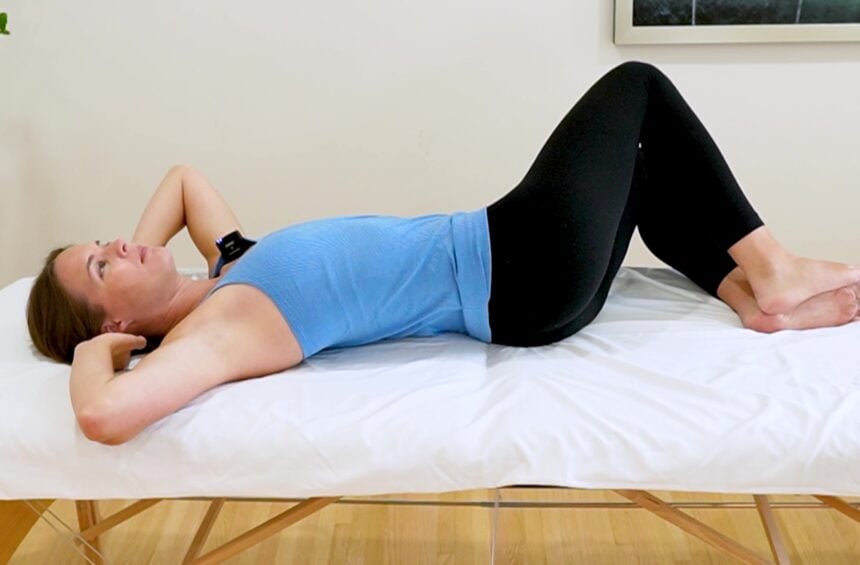
If you had radiation to your breast or chest, focus on stretching your pec muscles, which run across the front of your chest to your shoulder. These muscles often get tight after radiation and can pull your shoulder forward.
Keep your stretches gentle and build up gradually. Start by holding a mild stretch for 5 to 10 seconds, then work your way up to 30 seconds or even 1 minute as your body adapts.
Take slow, deep breaths while you hold each stretch. Radiation to the chest can affect the intercostal muscles, which are the small muscles between your ribs. They’re very hard to reach with hands-on techniques, but deep breathing expands your ribcage and helps mobilize them from the inside.
You can get started with these physical therapy exercise guides:


Manual techniques
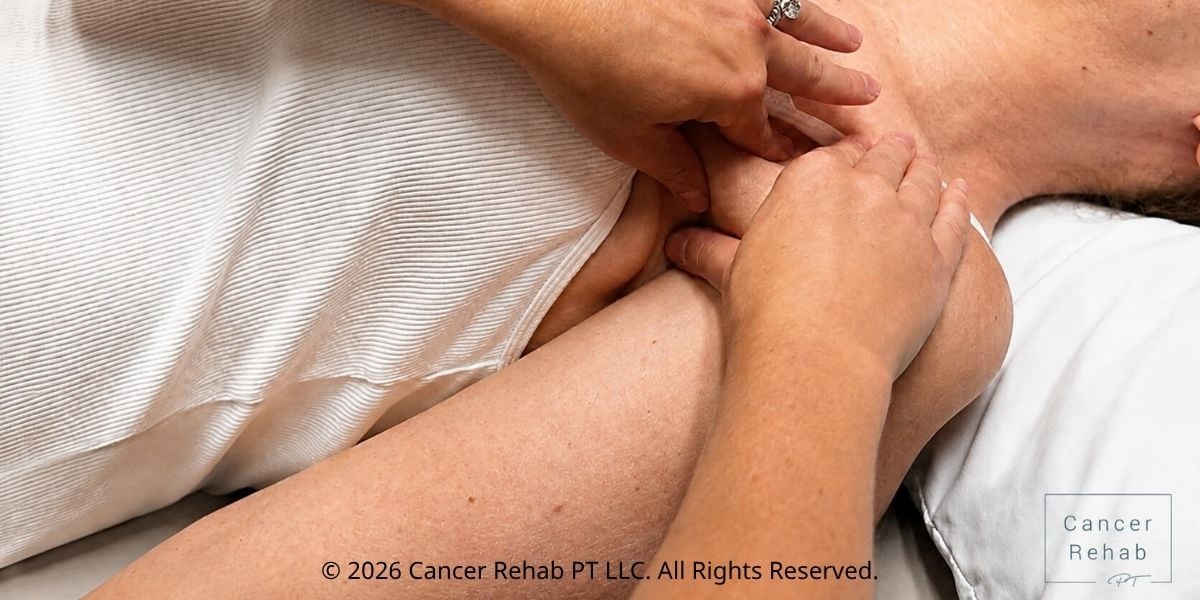
Fibrotic tissue doesn’t have the elasticity of healthy muscle, so it doesn’t stretch well. Stretching alone won’t be enough to loosen it, which is why hands-on manual techniques are such an important part of treatment.
Think of fibrotic tissue like a sheet of paper. Paper doesn’t stretch, but if you gently crumple it over and over, it starts to soften and break apart. Manual therapy follows a similar idea.
Techniques like tissue rolling and myofascial release gently knead the tissue, almost like kneading dough, to help soften the fibrosis and get it moving again. This should always feel comfortable.
When I’m working through stubborn radiation fibrosis or scar tissue, I don’t go straight to the deepest point of restriction. I work through it layer by layer using my 3-layer system:
- Layer one is the skin and outer fascia
- Layer two is the deeper fascia and outer muscle
- Layer three is the mid to deeper muscle and tissue
This isn’t the only way to approach radiation fibrosis, but it’s how I like to figure out what’s restricted before jumping to conclusions.
If you go straight to the deepest tissue, it’s easy to miss what’s happening at the surface. If you stay at the surface, you can miss what’s happening deeper. Working through each layer helps make sure everything that needs support gets addressed.
Physical activity
Exercise improves blood flow to the treated area and helps you build the strength you need for good posture. This is important after breast cancer, since tight chest muscles tend to pull your shoulders forward.
Exercises that strengthen your upper back, like rows and shoulder blade squeezes, help balance out that tightness in your chest. Make sure to go low and slow. Start with light resistance and increase the intensity gradually. Doing too much too soon can cause inflammation and set back your healing.
Other therapies
Stretching, manual techniques, and exercise are the foundation of radiation fibrosis treatment. A few other therapies can support them:
- Cupping, done by a trained therapist, can lift and mobilize tissue that’s hard to grab with hands
- Instrument-assisted soft tissue mobilization (IASTM) uses specialized tools to reach and loosen deeper tissue
- Low-level laser therapy may help reduce inflammation and support healthier collagen, though more research is needed
- Compression garments can help manage swelling or lymphedema that develops alongside fibrosis
Whichever therapies you use, keep track of your symptoms over time. Notice what feels better and what feels worse, and adjust your routine so you keep making progress.
Does Radiation Fibrosis Ever Go Away?
Radiation fibrosis may not disappear completely, but it can improve a lot. With consistent treatment, fibrotic tissue can soften, tightness can ease, and you can get back range of motion in your chest and shoulder.
Because radiation fibrosis is a dynamic healing process, the tissue keeps responding to what you do. Even if your radiation ended years ago, you can still see changes with consistent stretching, manual work, and strengthening.
If you’d like guidance on what to do at home, my Breast Cancer Rehab program can help you get started and build your strength and mobility back up after treatment.
For Clinicians: Radiation Fibrosis Management in Rehabilitation
If you’re a clinician who works with breast cancer survivors, you’ve likely treated a patient whose tissue stopped responding or who kept plateauing. Most of us learned very little about fibrosis in our training, and the research on how to treat it hands-on is limited.
I created Fibrosis Management in Rehabilitation to fill that gap.
It’s a self-paced CEU course that teaches you how to assess and treat both radiation fibrosis and lymphostatic fibrosis hands-on, with 6.5 contact hours. It’s the framework, manual techniques, and clinical reasoning I use in my own practice.
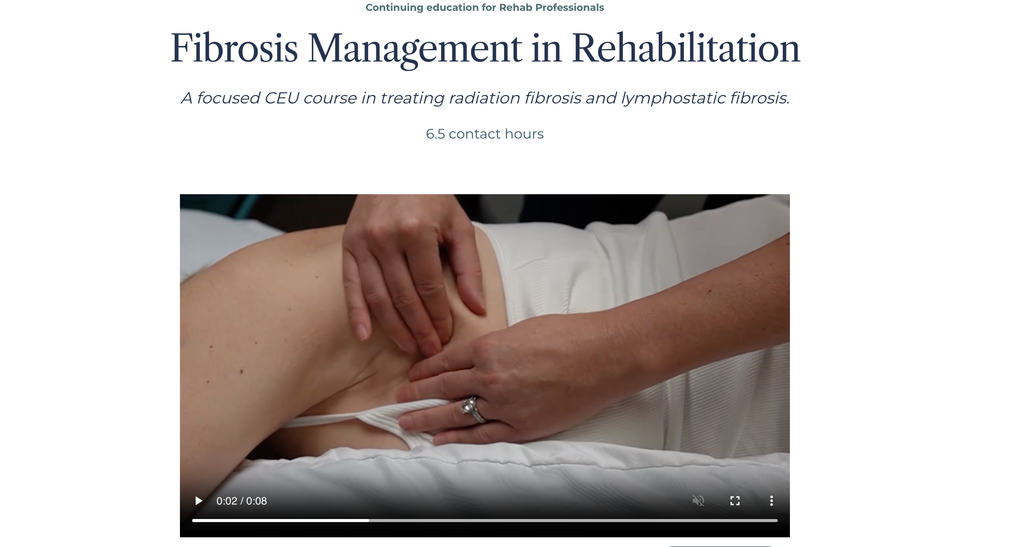
The course teaches you my Fibrosis Rehab Framework™, which walks you through four steps: identifying whether it’s fibrosis and which type, ruling out other causes of symptoms, assessing the tissue layer by layer, and matching your technique to what you found.
Across seven video modules, you’ll learn:
- Why radiation fibrosis syndrome keeps progressing years after treatment ends and how it presents
- How lymphostatic fibrosis forms and what to do when standard CDT stops working
- How to assess tissue with pinch-lift, tissue slide, and depth palpation using the 3-layer framework, and how to document and track progress
- The manual techniques, stretch parameters, and strengthening I use to treat radiation fibrosis
- What to treat first when a patient has both types of fibrosis
Technique demonstrations for radiation fibrosis are filmed on the chest wall and breast, so the course is especially useful if you treat fibrosis after radiation for breast cancer.
It’s open to PTs, PTAs, OTs, COTAs, and CLTs, and includes downloadable reference lists, a post-test, a certificate of completion, and lifetime access.
Learn more about Fibrosis Management in Rehabilitation.
FAQs
How painful is radiation fibrosis after breast cancer?
Radiation fibrosis after breast cancer often feels more tight and stiff than painful. When pain does happen, it’s usually an ache or pulling sensation in the chest, breast, armpit, or shoulder, especially when you reach overhead or stretch. Tight chest muscles can also pull your shoulders forward, which can lead to neck and upper back pain over time.
How to break up radiation fibrosis after breast cancer?
Fibrotic tissue doesn’t stretch the way healthy muscle does, so hands-on manual techniques are the most effective way to soften it. Techniques like tissue rolling and myofascial release gently knead the tissue to help it loosen and move again. I work through fibrosis in layers, starting with the skin and moving into the deeper fascia and muscle.
What exercises are good for breast radiation fibrosis?
Gentle stretches for your pec muscles help keep your chest flexible after radiation. Start by holding each stretch for 5 to 10 seconds and build up to 30 seconds or 1 minute. Take slow, deep breaths while you stretch to help mobilize the muscles between your ribs.
Strengthening exercises for your upper back, such as rows and shoulder blade squeezes, help balance out tightness in your chest and support good posture. Start with light resistance and increase it gradually.
What does radiation fibrosis feel like in the breast?
Radiation-induced fibrosis in the breast often feels firm, thick, or dense compared to the rest of your breast tissue. Your skin may feel tighter and less flexible, and the breast may look or feel smaller as the tissue tightens. You might also notice a pulling sensation across your chest when you move your arm.
Any new lump or hard area should be checked by your oncology team to rule out other causes.
Get More Support in Breast Cancer Rehab
You don’t have to accept tightness, pain, and stiffness as your new normal after radiation. With physical therapy, your tissue can soften, and you can feel strong and comfortable in your body again.
Breast Cancer Rehab is my online breast cancer physical therapy program that can help with radiation fibrosis management as well as other common side effects of cancer treatment, such as lymphedema.
Learn more about Breast Cancer Rehab and join today!