

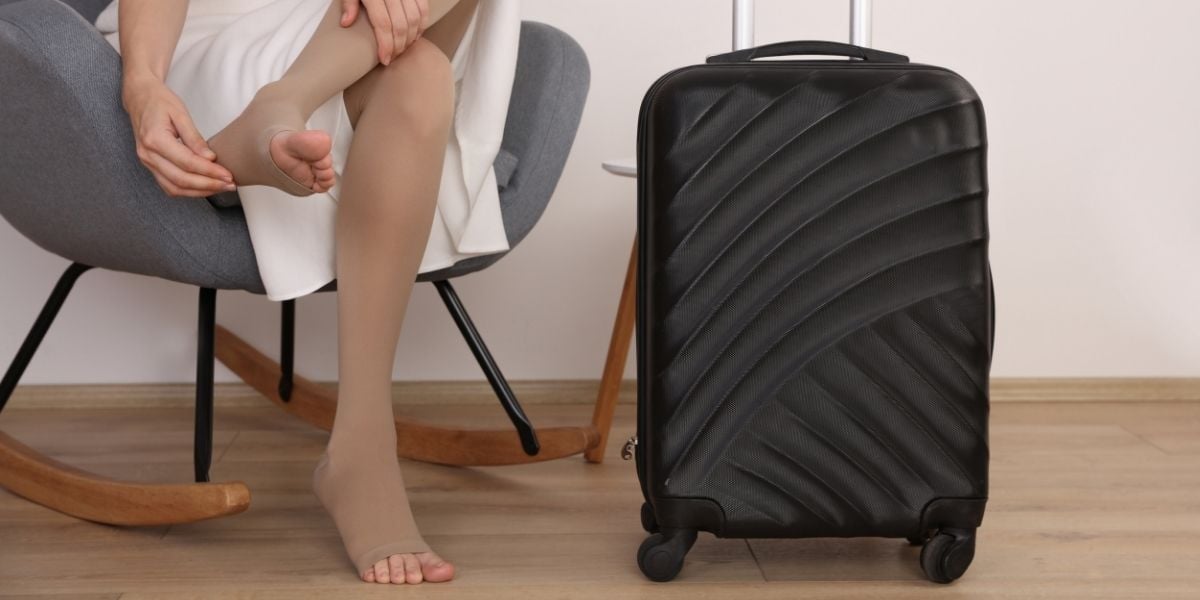
As a physical therapist and a certified lymphedema therapist (CLT-LANA), I often get asked about compression socks for flying. The most common questions are: Do I really need them? How strong should they be? When do I put them on?
Whether you’re a healthy traveler who just wants to avoid puffy ankles or a person managing lymphedema, a lymphedema risk, venous problems, or a history of blood clots, here’s everything you need to know about compression socks and how to use them when flying.
What Are Compression Socks for Flying?
When you fly, the cabin is pressurized, but not all the way down to sea level. Your circulation slows, making it harder for your body to move fluid back up from your legs. Add hours of sitting with your legs bent, and fluid starts to pool in your lower legs, ankles, and feet.
Swelling while on the plane is very common, and studies show that edema (the medical term for this kind of swelling) is present in around 97 in 100 people who fly for more than 7 hours.
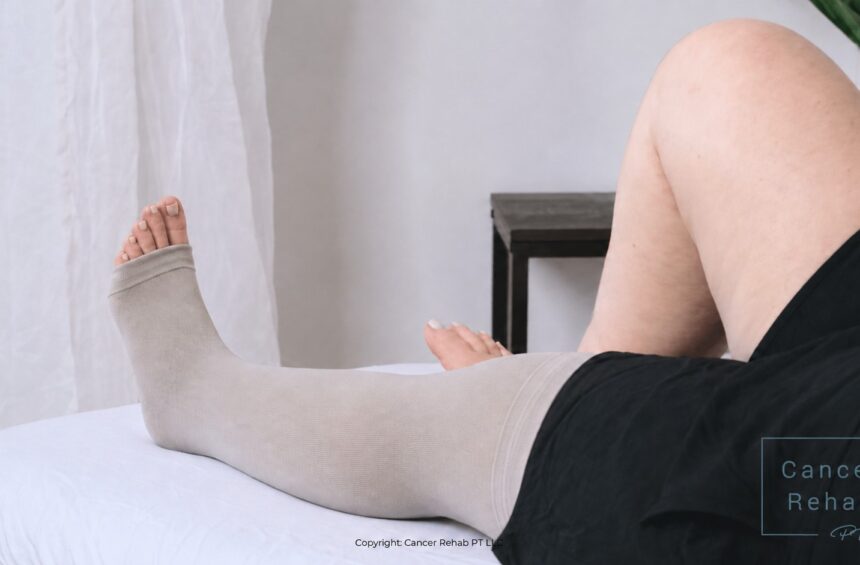
Compression socks are snug, stretchy socks that gently squeeze your legs to keep your lymph fluid moving. They’re tightest at the ankle and looser as they go up, which helps push fluid upward. For a healthy traveler, wearing compression socks helps reduce swelling. For someone at higher risk, it’s an important part of protecting your circulation on a long flight.
Why Are Compression Socks Good for Flying?
Compression socks help because they address the main problem a flight creates. When your circulation slows and you can’t move much, fluid settles in your legs, and compression keeps that fluid moving.
Four types of travelers benefit from wearing compression socks on a flight:
- Healthy traveler who has no diagnosed swelling condition, no recent surgery, and no history of blood clots, but wants to feel better on long flights
- Swelling-prone traveler who already notices puffy legs or feet by the end of a normal day, often from venous insufficiency or pregnancy
- Lymphedema or at-risk traveler who has had lymph nodes removed, had radiation, or lives with diagnosed lymphedema and knows that flying can trigger a flare
- Post-op or DVT-history traveler who has had a recent surgery, a blood clot, or both, and should plan compression with their medical team
Compression socks help healthy travelers get more comfortable, and at-risk travelers get a layer of protection for their circulation and to prevent dangerous blood clots or deep vein thrombosis (DVT).
Compression Socks for Flying Benefits
Wearing compression socks while flying helps you to:
- Keep fluid from pooling in your lower legs, ankles, and feet
- Ease heaviness and tightness that you often feel by the end of a long flight
- Support healthy blood flow
- Lower the risk of blood clots
- Make you feel less stiff and more comfortable when you stand up to get off the plane
For a healthy traveler, most of this is about comfort. But if you have a swelling condition, a clotting history, or you’re recovering from surgery, compression also lowers your risk of a flare or a serious complication like a blood clot.
Learn more about compression socks for lymphedema.
How Do Compression Socks Work for Flying
Compression socks work by applying gentle, steady pressure to your legs. That pressure supports your veins and tissue so fluid keeps moving up toward your heart instead of collecting around your ankles.
The socks you want for flying are graduated, meaning they’re tightest at the ankle and loosen as they go up your calf. That gradient is what moves fluid in the right direction. A normal sock with the same pressure top to bottom won’t do this, so graduated is the type to look for.
Compression strength is measured in mmHg, short for millimeters of mercury. A higher number means a stronger squeeze. There are four general levels:
- 8 to 15 mmHg is very light, cosmetic compression found in fashion and some athletic socks, and it isn’t considered medical grade
- 15 to 20 mmHg is the lowest true medical-grade level, and this is what most general travelers use
- 20 to 30 mmHg is usually an appropriate compression strength for people with more consistent swelling, mild lymphedema, venous insufficiency, or a history of blood clots
- 30 to 40 mmHg and above is for chronic lymphedema and is usually prescribed or fitted by a specialist
Most of the research on preventing flight-related blood clots is based on the 15 to 20 mmHg range, and it needs no prescription.
How to Wear Compression Socks for Flying?
Putting compression socks on takes a little technique, since they’re meant to be snug.
Reach into the sock, grab the heel, and turn the top half inside out down to that point. Slip your foot in, line up the heel, and then roll the rest up your leg. You’ll also want to smooth out any bunching as you go.
In terms of when to put compression socks on for flying, I recommend putting them on before your legs have had a chance to swell, ideally in the morning. If that’s not an option, get them on before you go through airport security.
Keep the socks on for the entire flight, and get up to walk the aisle every 60 to 90 minutes when you can. If you can’t move around, do ten ankle pumps at your seat now and then.
After you land, healthy travelers can take compression socks off once you’re up and moving. If you have a swelling condition, a clotting history, or recent surgery, leave them on for two to four hours after the flight, or until you’ve had a chance to elevate your legs.
Learn more about how to reduce swelling in legs and feet.
When Do You Put On Compression Socks for Flying?
My typical recommendation is to put them on in the morning before you leave for the airport or as you’re about to pass airport security at the latest. This is because once fluid has already settled in your legs, compression has a much harder time moving it.
What Are the Best Compression Socks for Flying?

Juzo Soft Knee-High Stockings
⭐⭐⭐⭐⭐
Softest Medical-Grade Pick for Flying
Best for: Travelers who want everyday-level compression that feels gentle on the skin through a full travel day.
💲 Price Range: $55-70
⭐ Compression: 15-20 mmHg
For most healthy travelers, 15 to 20 mmHg is the level I suggest for a flight, and Juzo designed these as their softest stocking in that range. The knit fabric has a lot of stretch, so pulling them on at home before an early flight takes less effort. A silicone band at the top keeps them from rolling down during hours in your seat. They’re opaque and come in five colors, so they look like regular knee-highs under a dress or pants.
You can also machine wash and tumble dry them on low, which makes it easy to wear them out and rinse them for the flight home.
Best compression socks for flying for women
Juzo Soft Knee-High Stockings
⭐⭐⭐⭐⭐
Softest Medical-Grade Pick for Flying
Best for: Travelers who want everyday-level compression that feels gentle on the skin through a full travel day.
💲 Price Range: $55-70
⭐ Compression: 15-20 mmHg
For most healthy travelers, 15 to 20 mmHg is the level I suggest for a flight, and Juzo designed these as their softest stocking in that range. The knit fabric has a lot of stretch, so pulling them on at home before an early flight takes less effort. A silicone band at the top keeps them from rolling down during hours in your seat. They’re opaque and come in five colors, so they look like regular knee-highs under a dress or pants.
You can also machine wash and tumble dry them on low, which makes it easy to wear them out and rinse them for the flight home.
Best compression socks for flying for men

Ames Walker Coolmax Knee High Socks
⭐⭐⭐⭐⭐
Best Breathable Pick for Travel Days
Best for: Travelers who run warm and need firmer compression for regular swelling, venous insufficiency, or a clotting history.
💲 Price Range: $30-40
⭐ Compression: 20-30 mmHg
Airports get warm, and a long walk between gates in tight socks can get uncomfortable. The Coolmax blend in these socks is made to move moisture off your feet, and the cushioned footbed helps during long security and boarding lines. At 20 to 30 mmHg, they give more support than a healthy traveler needs, so I suggest them for men who already deal with leg swelling or have had a blood clot.
They cost less than most medical-grade brands, so buying a second pair for the return trip is an easy call.
Best compression socks for flying long distance

Mediven Comfort Knee Highs
⭐⭐⭐⭐⭐
Best Firm Support for Long-Haul Flights
Best for: Long flights when you have swelling, mild lymphedema, venous insufficiency, or a clotting history and need firm compression for many hours
💲 Price Range: $65-90
⭐ Compression: 20-30 mmHg
On a long-haul flight, your compression has to keep working for many hours, and these stockings are great for extended wear. Medi’s fabric technology helps manage moisture and odor, so they still feel fresh after a travel day with layovers. Their 3D knit makes them easier to get on and off than many stockings at this compression level, which helps if bending or grip strength is hard for you.
They come in regular and wide widths plus a petite length, so you have a better chance of finding a fit that won’t bunch behind the knee. They cost more than the other picks here, but for long flights with a swelling condition, I think they’re worth it.
If you have lymphedema, check with your therapist that 20 to 30 mmHg is the right level for you before you fly.
What Level of Compression Socks for Flying?
It depends on why you’re wearing compression stockings or socks.
- Most general travelers do well in 15 to 20 mmHg, which is the lowest true medical-grade level and the one most flight research is based on
- If you swell regularly, have mild lymphedema, venous insufficiency, or a clotting history, 20 to 30 mmHg is usually the better fit
- Chronic lymphedema usually requires 30 to 40 mmHg or higher, which a specialist should prescribe or fit for you
If you’re pregnant, stay in the 15 to 20 mmHg range and check with your OB before moving higher.
And if you fall into the lymphedema or post-surgery group, confirm your level with your therapist before you fly, since the right compression for your leg in normal circumstances isn’t always the right level for a long flight.
Who Should Not Wear Compression Socks on a Flight?
Compression works for most travelers, but it may not be right for everyone.
Talk to your doctor before flying in them if any of these apply to you:
- Peripheral artery disease or poor arterial circulation
- Certain types of heart failure
- Skin infections, open wounds, or a rash on your legs
- Severe nerve damage or numbness that makes it hard to feel whether the sock is too tight
- Diabetes with nerve or circulation issues in the feet
Even if none of this applies, take the socks off mid-flight if you feel numbness, tingling, or pain, and get them checked for fit before you fly again.
Learn more about sleeping in compression socks.
FAQs
How tight should compression socks be for flying?
Snug and supportive, but not painful. For most travelers, that means 15 to 20 mmHg, which you’ll feel firmly, but it shouldn’t leave you numb or in pain.
Where to buy compression socks for flying?
Light wellness-grade socks are easy to find online and in retail stores. For true medical-grade compression, buy from a medical supply brand or through a specialist so you get the right level and fit.
Are ankle compression socks good for flying?
No. Ankle-length socks skip the calf, so you lose the graduated squeeze that moves fluid up your leg. I recommend going with knee-high graduated compression socks for flights.
How high should compression socks be for flying?
Knee-high medical-grade compression socks are the standard for flying. That length gives you graduated compression from ankle to calf and keeps the fluid moving in the right direction.
Should I wear compression socks when I fly?
Generally speaking, yes. For most flights over a couple of hours, they’re worth it. If you have a swelling condition such as lymphedema, a clotting history, or recent surgery, you’ll likely need to wear them regardless of how long you’re in the air.
How long before the flight do you put compression socks on?
I recommend putting compression socks on in the morning, before you leave home for the airport. At the latest, put them on before you go through security. This is because it’s much easier for compression socks to prevent swelling than to make it go down once you’re already in the air.
What type of compression socks do I need for flying?
Graduated, knee-high, and closed-toe. Closed-toe keeps your feet warm in a cold cabin, and if you’re in medical-grade socks, look for a silicone top band so they don’t roll down.
Is 20/30 mmHg compression socks too much for flying?
For a healthy traveler with no swelling issues, 20 to 30 mmHg is usually more than you need, and 15 to 20 is more appropriate even for long-haul trips. If you have chronic swelling, mild lymphedema, venous insufficiency, or a clotting history, 20 to 30 is often the right call.
Looking for More Support with Swelling?
I’m Kelly, a physical therapist and certified lymphedema therapist (CLT-LANA), and I help people manage day-to-day swelling and lymphedema. Flying is one small piece of that, but if you want more support, I have a few places to start.
Lower Body Lymphedema Rehab walks you through managing leg swelling, and my Shop has digital guides you can use at home, including manual lymphatic drainage and vibration plate routines.
You can also get started with my FREE Guide: